
The wrapping paper is cleaned up and the boxes stacked in a pile waiting to be recycled. All of the kids are both elated and overstimulated as parents come down from the mad push to make the holiday magical. The post Christmas slump is a real thing. I was out of steam, the kids were listless but also hyper and the house was still a mess. And in the mix of all this, I felt guilt over teaching my kids that the point of Christmas was gifts. How am I going to battle a growing trend of entitlement if I keep giving them more and more things? In a move that shows this parent can learn new things, I decided to tackle the kids’ “give me more” attitude one step at a time. Since I recently shared a ton of research on gratitude, we are started there. I developed a practical, simple, actionable activity to help our family get back on track and moving in the right direction. Since not all people love crafts, I also included a digital way to participate in this activity. I hope this gratitude activity for kids will help combat entitlement in your family just like it has been helping us in our home.
Gratitude Activities for Kids
Is This Going to Work?: What the Research Says
How Can I Do the Gratitude Activity for Kids?: Steps to Follow
Will this Take a Take a Long Time?: Time Modifications for Every Schedule
Do You Have a Non-Craft Option?: Digital Gratitude Activity
Did this Actually Combat Entitlement with Your Kids?: What Happened in My Family
Is This Going to Work-What Is the Research on Gratitude and Combatting Entitlement?
Before you spend your limited time and energy on a gratitude activity for kids you might be wondering if gratitude helps with entitlement. Research shows that it does. A study published in the Journal of Consumer Research in March of 2020 reported “Through gratitude, consumers feel less entitled and see their resources as fortunate bounties rather than things they obviously deserve. We find that evaluating one’s own resources with appreciation and humility can shift one’s mindset from scarcity toward abundance, which in turn decreases materialism. (The research showed that) ….reductions in entitlement, perceived scarcity, and materialism were indeed driven by the experience of gratitude (Lee, Chugani, Namkoong, 2020).”
This study was done with an eye towards marketing practices, hence the mention of consumers. However, the study’s architecture was such that its findings are reliable indicators of human nature and applicable to the wider population. The upshot? Gratitude will decrease entitlement for us and our children. When people practice gratitude, they learn to appreciate what they have, rather than constantly wanting more.
So, how exactly does this activity help reduce entitlement? Gratitude encourages children to focus on what they have, rather than what they lack. By taking the time to write thank-you notes, kids actively engage in the process of appreciating the gifts they’ve received—both physical items and experiences—shifting their mindset from “I want more” to “I am thankful for what I have.” This simple practice helps combat the “give me more” attitude and encourages a mindset of abundance over materialism.

How Can I Do the Gratitude Activity for Kids- What Will It Take to Make this Happen?
Ready to give it a try? Let’s walk through the steps of the gratitude activity so you can start helping your kids develop appreciation right away. This activity gives a concrete avenue for expressing gratitude and that helps reduce feelings of entitlement. Best of all, it simple, inexpensive and won’t take an entire day to complete.

Materials Needed for Simple Thank You Notes
- Thank You Cards – ready to write cards or card bases waiting for color or card stock from home for a fully customizable option.
- Printable Images – Fun images for kids to color and attach to the front of the thank-you cards if you plan to start with blank paper.
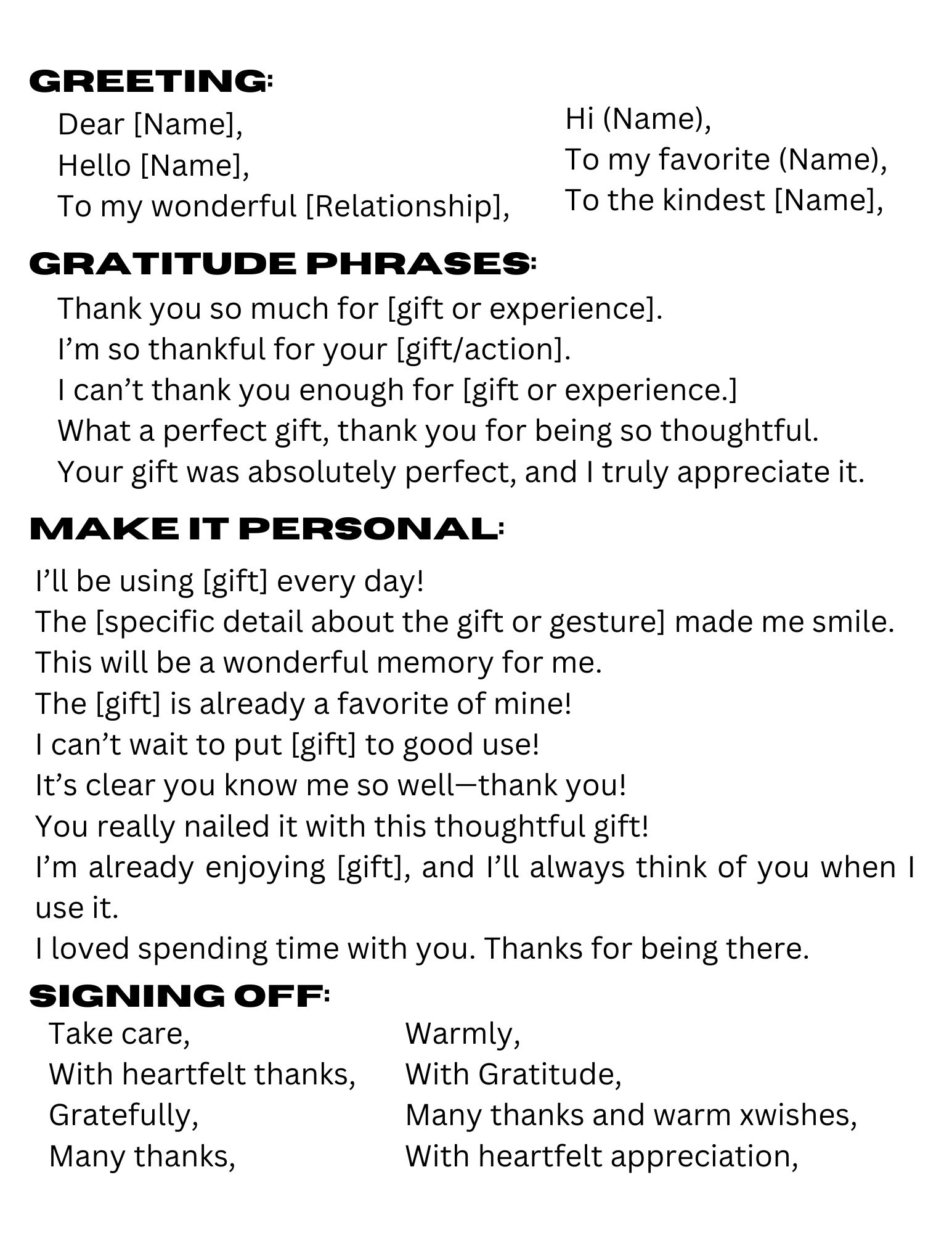
- Word Lists – A printable list of simple words (e.g., “thank you,” “thankful for,” “toy,” “books,” “time,” etc.) that kids can use to complete their thank-you notes.
- Markers, crayons, or colored pencils – For decorating the cards and images.
- Glue stick or tape – To attach the colored images and words to the cards.
Printables Index
- Card Bases: Ready for Kids To Add Color
- Card with Decorated Exterior and Blank Interior
- Words
- Character and Image Sheets
- Templates


How to Steps
- Step 1: Print and Prepare Materials
- Take a look at the “how to” templates provided. If you want your kids to see it, go ahead and print it now.
- Print out the thank-you cards (either black and white or with already decorated) and the coloring images. The images will be pasted to the front of the cards.
- Print the word lists for kids to use. These include words and phrases like “thank you,” “books,” “time,” “toy,” “idea,” and “thankful for.”
- Step 2: Discuss the Activity with Your Kids
- Take a moment to talk with your kids about gratitude. Explain how important it is to say thank you for the gifts they’ve received, whether it’s a physical object or an experience like time spent with family. Gratitude is important, so we are going to practice.
- Share how a simple note helps our hearts and also connects us to those who care enough to gift us things when they do not have to.
- Give an overview of the project. Coloring the card or an image, gluing the image to the card face, remembering the gifts, writing our thank you, sending the card off, knowing we participated in building the relationship.
- Step 3: Color and Decorate the Cards
- Give each child a printed sheet that has the and ask them to color one of the printable images (e.g., a gift, heart, or smiley face). They can use markers, crayons, or colored pencils.
- Encourage creativity—kids can even mix and match images to make the cards more personal.
- Young Kid Modification: Have the characters already cut apart so all they have to do is add color.
- Non-crafty Kid Modification: Allow them to leave the card with a black and white aesthetic, or print out an “all-in-one” card to eliminate the need to do any cutting or glueing.
- Step 4: Write the Thank-You Notes (Or Cut and Glue the Notes)
- Have your child pick a word or phrase from the printable word list to begin their thank-you note. For example, they might start with “Thank you for the toy,” “I am thankful for the books,” or “I had so much fun with you.” Cut out the phrase and keep it with the card.
- For older children, they might choose to write their own words and forgo the printed word sheets.
- Younger Child Modification: Cut out the words in advance. Then, line them up and help them choose the words they want to include with that card. Finally, set only the few words they chose in front of them to glue. Set aside the others for the next card. If you don’t do that, you might end up with one card that has 25 words and no words left for the others! Ask me how I know.
- Grab your blank card, the words your kiddo chose, and the image your child colored. Have them glue the words and images in the card in whatever order they wish.
- My 7 year old had a logical setup with character on the outside and words on the inside.
- My 4 year old put everything, everywhere and I went with it . This is about her learning process, not my desire for something to look “good.”
- Step 5: Review and Sign
- Once the note is written, go over it with your child and read it aloud. Discuss the message to make sure it is accurate. (Did Aunt Janni actually give you the truck or did she give you a book?)
- Have your child sign their name inside the card.
- Younger Kid Modification: Do hand-over-hand so that they are a part of signing their name.
- Step 6: Deliver the Cards
- You can hand deliver the cards to people that live near you. I do not suggest keeping them in your car until you see them unless you are a very efficient person. When I have done this, the recipient never recieved their card.
- Get the notes in envelopes, address it, stamp it and get it in the box. If you do not have a person’s address just text them for it. I used to go through my mother in law to get aunt’s and uncle’s addresses but now I just send a text.
- Your kids can help with the mailing process. Bonus: it’a a lesson on addresses and the postal system.
- I highly suggest doing this within one day of writing your cards. Otherwise, they might end up in the recycling pile. (Or you will find them in March (raises hand).) The act of writing will still be beneficial to you and your kids, but why not go that last tiny step to strengthen the relationship with the person who gifted you?


Tips For Success
- Plan on being engaged in the process. Unless you have trained your kids before this, they will need you to be present or even seated with them in order to produce thank you notes. This is a gratitude activity for kids, but they will need some grown up assistance.
- Be prepared to share your own gratitude. Think of examples. “I really like my new shirt. It is a new color and I can’t wait to try it out.” Or, “Papa was really thinking about me when he got this utensil holder. I hate having a dirty stove top and I feel really loved that he helped me solve that problem.” Or, “Aunt Susan really blessed me when she hosted us for Christmas dinner. I wanted family time but our house doesn’t fit the whole family. I am so thankful we had a place to go to be together.”
- Let go of your aesthetic goals. These cards might look rough from an artistic viewpoint. Colors might clash, lines will be crooked, and the design might be nonexistent. That does not matter and if you get hung up on that, you will kill your kids’ freedom to express what we all need, gratitude. Focus on the words and the feelings of thanks. View the art as a vehicle for gratitude.
- Make sure things are ready to go. I started this project while still printing and we never seemed to get organized. The project stretched on and on because I was giving directions willy nilly. If printables are ready, card stock cut, glue is handy, and markers on the table, then you can dive in and the process will run smoothly.

Is This Gratitude Activity for Kids Going to Take a Long Time?
As parents we care about a lot of things. If you are reading this, you care about your kid’s character development. And, you care about the other 100 things that it takes to make life work. You might be asking, can I fit this into our busy lives? Yes, you can make it fit. Whether you have 15 minutes or a few hours, you can customize this gratitude activity for kids to fit your schedule as well as your kids’ personalities and ages.
How Much Time Do You Have?
60 Minute Option:
The way the activity is written, you will need to commit 30-60 minutes for making the cards. It then takes another 15-30 minutes to address the cards and get them in the mail. In this time frame, you can reasonably plan to make and send 5-10 cards, depending on the ages and artistic drive of your kids. If you introduce glitter glue (like I did) you will have to incorporate drying time which is annoying, but cute.
With more time, you can let the kids take care of most of the cards. I suggest you stick around to help with spelling and to mitigate over enthusiastic glueing, but you won’t need to be sitting with the kids the entire time.
30 Minute Option:
In order to save some time, reduce the customization. Instead of doing everything from scratch, utilize the pre-made cards available. Make use of the fill in the blank spaces so that your cards remain personal, but don’t require as much creativity to produce. Have the printed cards on the table, pens for writing, and colored pencils or markers for them to add some color to the cards.
You will need to be involved to speed things up. Plan to stay at the crafting table or very close in order to get this done quickly. Also, plan on doing most of the writing, or at least the reading. Younger kids take a long time to glue things in place, so a parent or older child can help out here. Older kids will be capable of the steps, but will need your organizational skills to keep them moving from one thing to the next.
15 Minute Option:
If you only have 15 minutes, you need to go super basic. Express gratitude simply and clearly. Consider keeping the colors in black and white or only allowing a few markers on the table. Once the words are in place, you can always let them add artistic touches if there is extra time. Provide pre-printed cards, an idea sheet on gratitude phrases.
You will need to be highly involved. Most likely, you will need to act as a scribe for your kids. Example: First, they choose the card from the stack on the table. Then, they tell you who they want to give it to. Next, you use the template provided and give them two options on what gratitude words they want to use. After that, ask them what they like about the gift and how what they see themselves using it. Almost done, they choose to say thanks again, or i appreciate you. The final step is signing their name, but the fastest way to do this is sign all the completed cards at the end. So, put the almost finished card aside, grab the next card, repeat the process. When you are all done, then have them sign everything all in one go.
Ultimate Time Saving Ideas:
- Use Pre-Made Cards. Instead of making your own notes, buy thank you notes in order to expidite the gratitude activity kids.
- Utilize the idea scripts provided so you can focus on the gratitude feelings instead of getting the wording just right.
- Play Scribe for your child. Don’t use the printable words but instead have your kids speak their gratitude as you write it down.
- Get a friend or partner involved. Having more grown ups means that the tedious parts will go faster.
- Save time on mailing. Make the cards, take good pictures of them, and then text the pictures to people.
- Send fewer cards. Less cards means less time.
- Before you begin, have a list ready of who gave your family which gift. Then, producing the cards is as simple as stating what you received and how you are thankful for the gift.
- Do not make your own cards. Instead, use the back of one of the kids’ cards to write your own note of thanks to the family and friends who gifted you time, resources, and/or emotions.

Is There a Non-Craft Option?
I am glad you asked, there really is an option for the glue adverse. (My brother hated crafts growing up!) Some kids just hate sticky fingers and sometimes glitter glue on the table is too much to handle. Your family can still reap the rewards of gratitude activities for kids and start the healthy habit of intentionally saying thank you.
- Start out by printing off some of the gratitude templates and words lists. Even though you won’t be cutting and gluing, reference is helpful for everyone.
- Then, decide the best avenue of gratitude for your family. You can:
- Call everyone on your list of “thank you’s” and leave messages or talk live.
- Write thank you texts (or emails) as a group. Each person can type or dictate their own thank you.
- Make short 10-20 second videos to send out.
- Send a voice recording.
- Next, grab your phone or computer.
- Now, it’s time to wrangle up the kids into a single room.
- After that, briefly describe what you are going to do.
- Example, “Kids, we are going to spend the next little bit saying thank you to the people who have shown us love and care this Christmas. Each of us will get a chance to tell the people in our lives thank you for something we received. Here are some ideas (hand out the idea sheets.) Each one of you will tell me what you are thankful for, I will write it in the text message (or email) and then we will send it.”
- Finally carry out your plan.
- If you are texting (or emailing); First, tell everyone the name of the first recipient. Second, remind them what they received. Third, give them a chance to think about why they like the gift. If the present was odd (that happens) help them find something good about the gift. Fourth, write down what each kid tells you. Fifth, send the message off. Sixth, let go of your expectations. The recipient will get the message and appreciate it or not. You and your crew showed gratitude and that is all you can control.
- Do you all like to send videos? If so, make sure you do a few sample run throughs before you get going. It makes sense to practice first which saves time in the long run.
- If you want to call live, then choose a time you think people will be home or available.
- For voice recordings, provide guides for the kids. Example, “We are not going to talk at once. I will be the director and let you know when it is your time to talk.”

Real World Test of the Gratitude Activity for Kids: Did This Work?
Do you want to know if there will be a return on investment? Before I spend time, emotional energy, and mental capacity I want to know if it will be worth it! So, will your investment into this activity be worth it? Will my kids act less “entitled” at the end? Before I dive into how this gratitude activity impacted our family, let me be honest: managing post-Christmas entitlement isn’t an overnight fix. However, I did observe some noticeable shifts in behavior, and I think you’ll find them encouraging. Here is how this gratitude activity played out in our home and what it might do at yours.
Before the Activity
It was the day after Christmas and all through the house, piles were toppling and I had lost my spouse. Just kidding. He was at work. Not missing under piles of boxes waiting to be recycled. However, our house was full of things everywhere. All three kids and I were feeling the classic after Christmas listlessness. My kids, thankfully, do not fight a lot, but they kept “nipping” at each other like little terriers. I was overwhelmed by the mess near the tree, in my kitchen, and in the kid’s rooms. With all the books and indoor toys we received (thank you gracious relatives!) we had plenty to do but not much energy to use them. And, the kids told me about what they didn’t get and what they wanted next. Since I wanted to write this blog article anyway, I decided “what is one more element of chaos? Leave the mess and start the project.”
During the Activity
I announced that we were going to do a craft and let the kids help choose images they wanted to color. This got them pretty excited. D and Cc scooted over to my computer at a run and eagerly poked at my computer screen. The littlest kiddo (he is one) just loves when his sisters are jazzed so he immediately perked up. I eventually got everything printed and we sat down at the table to start coloring.
As the colors came out, the energy became increasingly focused and upbeat. I let the one year old start to color as well, only to discover that he likes to eat markers. AHHH! Won’t do that again for awhile! Each child eagerly added color to the different images and I told them we would be adding the images to cards and then saying thank you. They were interested in this.
After everything was colored, the kids cut out their pictures. The one year old was eating snacks instead of markers in his high chair. The four year old started to lose focus and so I let her run off. She grabbed her new hopping ball and excitedly bounced around the house. The seven year old kept creating like mad. When the oldest was done coloring, I called everyone back to the table and we started the writing process. Cc, the four year old, and I utilized the pre-made cut outs. I read them, she told me who got what, and then she pasted them in. After 4 cards she was ready to go hop around again. The seven year old, D, happily put together 8 cards before she was done. She chatted about the gifts. D talked about the images she wanted to go to each person.
After the Activity
When all the cards were completed, I had the kids help me clean up the paper scraps and then let them go play. Their energy levels went from listless and overstimulated to engaged and focused. They ran off from the table and developed this game called lady bug. (Someone hops around on a ball while another person chases them. No idea where the lady bug comes in!) Giggles rang out to accompany the ‘boom-boom’ of the ball meeting the ground. I felt annoyed at the craft mess but also a lot more settled. My listlessness was gone and I felt ready to leave the mess for the next day. I hopped on the tiny bike the 1 year old received and joined in the “lady bug” game. I didn’t hear “I want more” for the rest of the day, which felt like a win in itself.
So, did the gratitude activity for kids “work”? That night at dinner when I brought up gratitude, the kids were able to engage in the conversation with ease. I know that the mood of the house shifted when we completed the project. Everyone went from sluggish to energized. I also can report that my kids now eagerly play with the things they received. No one has asked for anything new yet. Imagination is overflowing in the house as the kids keep coming up with creative ways to play with their things and one another. I have not heard “mine, mine, mine” at all. We haven’t had a complete transformation, but I am noticing fewer instances of entitlement and more gratitude in everyday interactions. As for me, the Christmas mess is still visible in places, but my ability to tackle it has felt attainable rather than impossible.
As we wrap up, I’ll leave you with this: whether or not you’re able to fully eliminate post-Christmas entitlement, this simple gratitude activity is a great first step toward fostering appreciation in your home.

Incorporating gratitude into your family’s holiday routine is more than just a feel-good exercise—it’s a powerful tool for shifting mindsets and reducing entitlement. By taking the time to engage in a simple, creative gratitude activity for kids, you’re not only helping them appreciate the gifts they’ve received but also teaching them the value of humility and appreciation for what they have. And, you will strengthen relationships with people both near and far. While the post-Christmas slump can leave everyone feeling overstimulated and listless, this gratitude activity has the potential to build character and bring positive change, fostering an environment of appreciation and connection.
Whether you have 15 minutes or an hour, this activity can be tailored to fit your family’s needs, making it easier to implement into your busy life. And while it may not eliminate entitlement overnight, the small steps you take today—through thank-you notes, thoughtful conversations, and focused family time—can have lasting effects on your children’s attitudes toward gifts, generosity, and gratitude.
So, give it a try and watch as your family moves from the chaos of the holiday aftermath to a place of genuine appreciation and joy. The mess can wait—what matters most is the love and gratitude shared in the moments that follow.
References and Further Resources
Hyunjung Crystal Lee, Sunaina Chugani, Jae-Eun Namkoong, “The Role of Entitlement and Perceived Resources in Gratitude’s Effect on Materialism: Evidence from Two Longitudinal Experiments”, Journal of Consumer Research, 2024, SSRN, https://doi.org/10.2139/ssrn.3650833 (accessed December 28, 2024).
Witvliet, C. vanO. (2018). Gratitude predicts hope and happiness: A two-study assessment of traits and states. Hope College Faculty Publications, 1464.
Confino, D., Einav, M. & Margalit, M. Post-traumatic Growth: The Roles of the Sense of Entitlement, Gratitude and hope. Int J Appl Posit Psychol 8, 453–465 (2023). https://doi.org/10.1007/s41042-023-00102-9.